
Introduction: The Global Workforce Challenge
The modern workplace has transcended geographical boundaries. Companies now operate with teams scattered across continents, from software developers in Bangalore to marketing specialists in London to customer success managers in San Francisco. This distributed model offers tremendous advantages—access to global talent, around-the-clock productivity, and diverse perspectives—but it also introduces one of the most persistent challenges in modern business: time zone coordination.
Consider this scenario: A product manager in New York needs to schedule a sprint planning meeting with engineers in Poland, designers in California, and stakeholders in Singapore. Finding a single hour that works for everyone seems like solving an impossible puzzle. The New Yorker's 9 AM is the Pole's 3 PM, the Californian's 6 AM, and Singapore's 10 PM. Someone will inevitably sacrifice their personal time, their sleep, or their family dinner.
This challenge isn't merely logistical—it's deeply human. Poor time zone management leads to burnout, resentment, and attrition. It creates invisible hierarchies where some team members consistently bear the burden of inconvenient meeting times while others enjoy the privilege of working during their preferred hours. Left unaddressed, these inequities erode team cohesion and organizational culture.
This comprehensive guide explores strategies, tools, and practices for mastering time zone management in global teams.
Part 1: Understanding Time Zone Fundamentals
The Geography of Time
Before diving into strategies, it's essential to understand how time zones work. The Earth is divided into 24 primary time zones, each roughly 15 degrees of longitude apart, corresponding to one hour of time difference. However, the reality is far more complex than this neat division suggests.
Political boundaries often override geographical logic. China, despite spanning five geographical time zones, operates on a single official time. India uses a half-hour offset (UTC+5:30) that doesn't align with the standard hour-based system. Some regions observe daylight saving time while others don't, and those that do often change their clocks on different dates.
These complexities mean that the time difference between two locations can change throughout the year. London and New York are five hours apart for most of the year, but for a few weeks during spring and fall—when one region has changed clocks but the other hasn't—the difference is four or six hours. Teams that assume static time differences will inevitably encounter scheduling chaos during these transition periods.
Calculating Overlap Windows
The foundation of global team coordination is identifying overlap windows—periods when multiple team members are simultaneously available during reasonable working hours. For teams spanning modest time differences (three to five hours), finding overlap is relatively straightforward. For teams spanning extreme differences (twelve or more hours), overlap may not exist at all within standard working hours.
Consider a team distributed across San Francisco (UTC-8), London (UTC+0), and Tokyo (UTC+9). San Francisco's working day (9 AM to 6 PM) corresponds to London's 5 PM to 2 AM and Tokyo's 2 AM to 11 AM. There is literally no hour when all three locations are within normal working hours. Any synchronous meeting requires at least one participant to work outside their preferred schedule.
Understanding these realities is the first step toward equitable solutions. Rather than pretending everyone can work "normal hours," effective global teams acknowledge the sacrifices involved and distribute them fairly.
The Human Cost of Time Zone Strain
Research consistently demonstrates the health and performance impacts of working outside one's natural circadian rhythm. Chronic sleep disruption is linked to cardiovascular disease, weakened immune function, cognitive impairment, and mental health challenges including depression and anxiety.
When team members regularly attend meetings during their evening or early morning hours, they're not just losing personal time—they're accumulating physiological stress that affects their work performance and long-term health. Organizations that ignore these impacts do so at their own peril, as burned-out employees become disengaged, make more errors, and eventually leave.
Acknowledging this human cost should inform every time zone management decision. The goal isn't just to find times that technically work, but to create sustainable practices that protect team members' well-being.
Part 2: Strategies for Equitable Scheduling
Rotating Meeting Times
The most fundamental principle of equitable time zone management is rotation. Rather than fixing meetings at times convenient for headquarters or majority locations, rotate meeting times so that the burden of inconvenient hours is shared across all participants.
Implementation varies based on meeting frequency. For weekly meetings, you might rotate through three time slots—one convenient for each major region—cycling every few weeks. For monthly meetings, you might alternate between two times that each favor different regions. For quarterly all-hands meetings, you might hold the same meeting twice at different times, allowing everyone to attend at least one session during reasonable hours.
Rotation requires advance planning and clear communication. Publish the meeting schedule well in advance so team members can plan around known commitments. Use calendar tools that clearly display times in each participant's local zone, preventing confusion and missed meetings.
Asynchronous-First Culture
The most powerful time zone management strategy is reducing the need for synchronous meetings altogether. An asynchronous-first culture prioritizes written communication, recorded updates, and collaborative documents over real-time discussions.
This approach recognizes that many activities traditionally conducted in meetings don't actually require simultaneous presence. Status updates can be shared via written reports or recorded video summaries. Brainstorming can happen in collaborative documents where participants contribute at their convenience. Decisions can be reached through structured asynchronous processes that give everyone time to consider options and provide input.
Building an asynchronous culture requires intentional practices. Document decisions and rationale in shared spaces where future reference is easy. Record important presentations so those who can't attend live can watch later. Establish response time expectations that are realistic given time zone differences—expecting same-day responses from someone who received your message during their night is unreasonable.
Protected Time Boundaries
While some synchronous collaboration is necessary for global teams, individuals need protection from unlimited availability expectations. Establish clear boundaries around when team members are expected to be available for meetings.
One effective approach is defining "core hours" for each major region—a window of four to six hours when meetings should be scheduled if possible. Outside these hours, meetings require explicit consent from affected parties and should be genuinely exceptional rather than routine.
Similarly, establish meeting-free periods for each region. Perhaps meetings involving Asian team members shouldn't be scheduled after 8 PM local time, or European colleagues shouldn't be expected to join before 8 AM. These boundaries create predictable structure that supports work-life balance.
Hub-Based Scheduling
For teams with members in numerous locations, hub-based scheduling simplifies coordination. Rather than trying to find times that work for everyone individually, identify two or three regional hubs and optimize for overlap between hubs.
For example, a company with employees in twelve countries might define three hubs: Americas, Europe/Africa, and Asia-Pacific. Meeting scheduling focuses on creating overlap between adjacent hubs (Americas-Europe and Europe-Asia) rather than attempting global synchronization. Information flows through these overlapping connections, with hub representatives ensuring their regions stay informed.
This approach accepts that not everyone will attend every meeting synchronously, but ensures that all regions are represented and that information flows effectively across the organization.
Part 3: Technology and Tools
Time Zone Conversion Tools
Basic time zone management requires reliable conversion tools. Built-in operating system world clocks work for simple conversions, but purpose-built tools offer more sophisticated capabilities.
Applications like World Time Buddy, Time Zone Ninja, and Every Time Zone provide visual representations of overlapping hours across multiple locations. They display working hours, lunch breaks, and night hours for each location, making it easy to identify meeting windows that fall within reasonable times for all participants.
Calendar applications increasingly include time zone features. Google Calendar and Microsoft Outlook can display multiple time zones simultaneously and will show event times in each invitee's local zone. When creating events, these tools can help identify times that fall within working hours for all participants.
Scheduling Automation
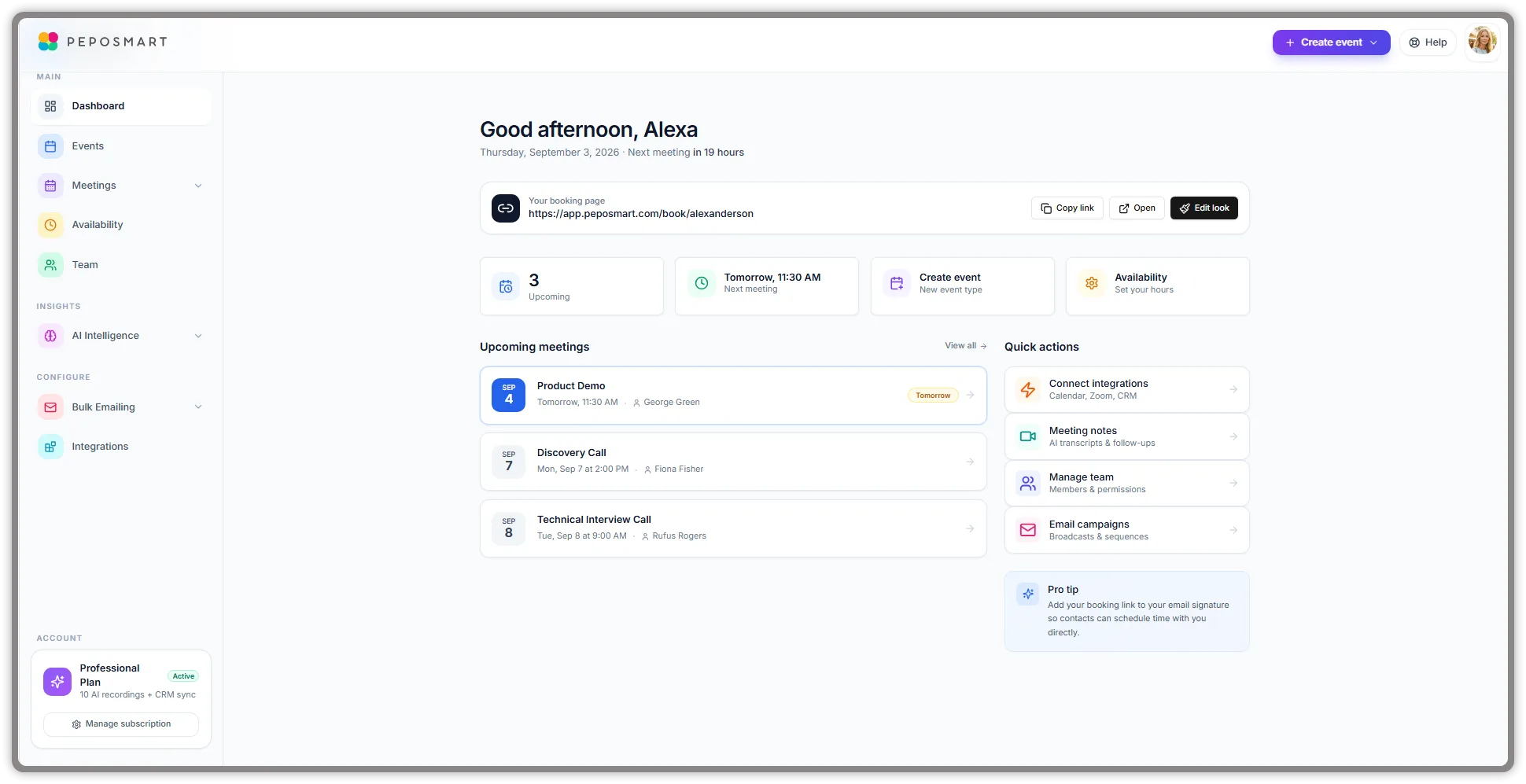
Modern scheduling tools like PepoSmart dramatically simplify time zone coordination. Rather than manually calculating overlaps and proposing times, these tools handle the complexity automatically.
When you share a scheduling link with international colleagues, the tool displays available times in each person's local zone. Preferences can account for time zone constraints—you might configure the system to only offer times between 9 AM and 6 PM in your zone, automatically filtering options that would be inconvenient for you.
For meetings with multiple required participants across zones, advanced scheduling tools can analyze everyone's availability simultaneously and suggest times that work for all. Some tools even consider travel time, buffer requirements, and meeting preferences when generating suggestions.
Calendar Display Best Practices
Proper calendar configuration is essential for global work. Configure your calendar to display your primary time zone prominently, but also enable secondary time zone display for locations you frequently coordinate with.
When creating events, always specify the time zone explicitly rather than relying on defaults. Many scheduling mishaps occur when someone creates an event while traveling or using a VPN that changes their apparent location. Explicit time zone specification eliminates this ambiguity.
Use descriptive event titles that include time zone information when inviting external participants who might use different calendar systems. "Product Review - 3 PM EST / 8 PM GMT" is clearer than just "Product Review" for a participant whose calendar might not handle zone conversion properly.
Part 4: Communication and Documentation
Recording and Summarizing
In global teams, not everyone can attend every meeting. Recording important meetings ensures that those in inconvenient time zones can catch up asynchronously. But recordings alone aren't sufficient—a one-hour meeting recording requires one hour to watch, which isn't practical for someone who missed several meetings.
Complement recordings with written summaries that capture key points in five minutes or less. These summaries should include decisions made, action items assigned, key discussion points and different viewpoints expressed, and open questions requiring further input.
Create a standard template for meeting summaries to ensure consistency and make it easy for summary writers to capture essential information. Store summaries in a searchable location where team members can easily find past discussions relevant to current work.
Establishing Communication Norms
Global teams need explicit norms around communication expectations. Without them, misunderstandings multiply. Someone sends an urgent message and becomes frustrated when they don't receive a response for twelve hours, not realizing the recipient was asleep.
Establish and document norms including expected response times for different channels (email might be 24 hours, Slack might be same-day during working hours), how to signal urgency for genuinely time-sensitive matters, which channels are appropriate for which types of communication, and whether "seen" or "acknowledged" responses are expected.
Consider time zones when choosing communication channels. Synchronous tools like phone calls and live chat are only appropriate during recipients' working hours. Asynchronous tools like email and recorded video are better for non-urgent communication that can wait for recipients to be available.
Language and Clarity
Global teams often include members whose primary language differs from the team's working language. This diversity is a strength, but it requires additional attention to communication clarity.
In written communication, use clear, simple language. Avoid idioms, cultural references, and jargon that might not translate well. Structure documents with clear headings and bullet points that make them easy to scan. When discussing dates and times, use unambiguous formats—"January 15" is clearer than "1/15" which could be interpreted differently in American and European date conventions.
In meetings, speak clearly and at a moderate pace. Pause to check understanding, especially when discussing complex or critical topics. Share agendas and key discussion points in writing before meetings so participants can prepare, looking up unfamiliar terms if needed.
Part 5: Building Inclusive Global Culture
Recognizing Regional Holidays
Different regions observe different holidays, and failing to account for this creates problems. Scheduling an important meeting on a day when key participants are celebrating a national or religious holiday shows insensitivity and results in poor attendance or resentment from those who sacrifice their holiday to attend.
Maintain a shared calendar of holidays observed in each region where team members are located. Reference this calendar when scheduling important events. For recurring meetings, proactively check whether upcoming sessions fall on holidays and reschedule or cancel as appropriate.
Go beyond just avoiding holidays to actively acknowledging them. Wish team members well on their important holidays. Create space for people to share their traditions with the team. This recognition builds connection across cultural differences.
Combating Proximity Bias
Proximity bias is the tendency to favor those who are physically or temporally close. In global teams, this manifests as headquarters or majority-time-zone team members receiving more opportunities, more attention from leadership, and more consideration in scheduling decisions.
Combat proximity bias through deliberate practices. Ensure that leadership roles and high-visibility projects are distributed across regions, not concentrated in one location. Rotate who facilitates meetings and who presents in all-hands gatherings. Track patterns in meeting scheduling to ensure no region consistently bears the burden of inconvenient times.
When making decisions, actively solicit input from all regions rather than just those who happen to be in the room. Use asynchronous input-gathering before synchronous discussions to ensure everyone's voice is heard regardless of their ability to attend real-time meetings.
Creating Connection Across Distance
Time zone differences can make team members feel isolated from colleagues they rarely interact with synchronously. Building connection requires intentional effort that accounts for these constraints.
Create opportunities for relationship-building that don't depend on synchronous availability. Asynchronous "get to know you" channels where team members share personal interests and experiences help people connect as humans, not just as job functions. Virtual coffee chat programs that pair people across regions for short video calls—with flexible scheduling to accommodate time differences—foster one-on-one relationships.
When synchronous gatherings are possible—whether virtual or in-person—invest in them fully. Annual or quarterly in-person gatherings that bring the global team together are worth the expense because the relationships built during these times sustain collaboration throughout the year.
Conclusion: Time Zones as an Opportunity
Managing time zones effectively is challenging, but it's also an opportunity. The practices required for global team success—clear communication, thorough documentation, inclusive scheduling, asynchronous work patterns—benefit everyone, not just those spanning time zones.
Organizations that master time zone management gain access to the world's talent, not just local talent. They can serve customers around the clock without requiring anyone to work night shifts. They build diverse teams that bring varied perspectives and approaches to every challenge.
The key is treating time zone management not as an afterthought or an inconvenience, but as a fundamental aspect of how global teams operate. Invest in the tools, establish the norms, and cultivate the culture that makes distributed collaboration sustainable.
Your team spans the globe. With the right approach, that global reach becomes your greatest strength.