
Coaching Scorecards
Every recorded call gets a score out of 100 — talk ratio, questions, filler words, pace — with trends and personalized exercises to improve.
PepoSmart scores each recorded call out of 100 from four measured components worth 25 points each — talk ratio, questions asked, filler words and engagement — normalised to a 30-minute call. The full formula, including every threshold, is published so the score can be checked rather than trusted. Scores roll up into 30-day trends and a team view.
| Available on | Starter and above. The team leaderboard requires Business. |
|---|---|
| Requires | A recorded meeting with AI Meeting Notes. Calls that were not recorded cannot be scored. |
| Limits | One scorecard per recorded meeting. Scoring is bounded by your plan's recording allowance. |
| Last verified | 19 September 2026 |
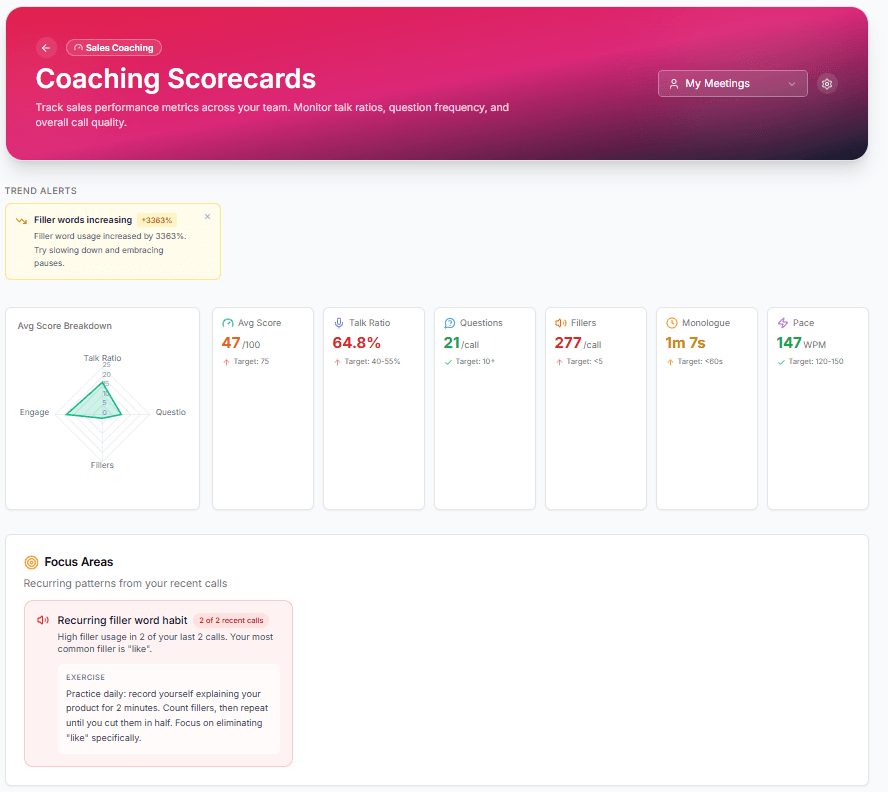
You can't improve what you don't measure. Coaching scorecards grade every recorded meeting on the mechanics that separate good calls from great ones: how much you talked versus listened, how many questions you asked, filler words, longest monologue, and speaking pace.
Scores roll up into trends — so you can watch your talk ratio drop and your score climb week over week — and trend alerts flag when a habit is creeping in. Each scorecard comes with focus areas: concrete, personalized exercises like practicing the pause instead of saying 'like' 195 times.
What you can do with Coaching Scorecards
A score for every call
Call score out of 100 built from talk ratio, questions per call, filler words, monologue length, and pace against healthy targets.
Trends and alerts
See your performance trend over 30 days and get alerted when a metric moves the wrong way — like filler words spiking.
Team leaderboard
On team plans, compare scores, talk ratios, and call volume across reps — and see who needs coaching before the quarter slips.
How it works
- 1
Record calls with AI Meeting Notes
Scorecards are generated from recorded meetings — no extra setup.
- 2
Review your scorecard
After each call: score /100, talk distribution, questions, fillers, monologue, and pace, each against a target.
- 3
Work the focus areas
Personalized exercises target your specific habits, built from patterns across your recent calls.
- 4
Track the trend
Watch scores improve over time, and use win/loss tagging to see which behaviors correlate with closed deals.
Everything included
- Call score out of 100 per recorded meeting, from four components worth 25 points each
- Talk ratio: full marks at a 40–50% host talk share
- Questions: full marks at 10–15 questions per 30 minutes
- Filler words: 25 points less 2 per filler word per 30 minutes
- Engagement: penalties for long monologues and for dominating the call
- Scores normalised to a 30-minute call, so a long meeting is not penalised
- Rating bands: Excellent 85+, Good 70–84, Average 55–69, Needs work 40–54, Poor below 40
- 30-day performance trend charts and alerts when a metric degrades
- Personalized focus-area exercises
- Win/loss deal tagging and correlation insights
- Team coaching leaderboard on Business
What Coaching Scorecards does not do
The limits, stated up front rather than discovered later.
- The score measures conversational mechanics in the transcript. It does not measure whether the call was useful, whether the product fit the buyer, or whether the deal will close.
- It should be read alongside the call itself and not used on its own to evaluate a person.
- The underlying counts inherit transcription errors, so audio quality affects the score.
Frequently asked questions
How exactly is the call score calculated?+
The score is the sum of four components worth 25 points each, normalised to a 30-minute call. Talk ratio scores full marks at a 40–50% host talk share and falls off outside 30–60%. Questions score full marks at 10–15 per 30 minutes. Filler words start at 25 and lose 2 points per filler per 30 minutes. Engagement starts at 25 and deducts for long monologues and for dominating the conversation. The complete formula, including every threshold, is published on our product facts page.
What does the score not measure?+
The score measures conversational mechanics found in the transcript. It does not measure whether the call was useful, whether the product fit the buyer, or whether the deal will close. Read it alongside the call itself, and do not use it on its own to evaluate a person.
Where do the metrics come from?+
From the transcript of each recorded call, so a call has to be recorded with AI Meeting Notes to be scored. Accuracy of the underlying counts depends on transcript quality, which varies with audio, accents and crosstalk.
Can I see my whole team's scores?+
Yes, on the Business plan. The leaderboard shows each member's score, talk ratio, questions, fillers, and call volume side by side. (Individual coaching and call scores are included on every paid plan.)
What are focus areas?+
Recurring patterns detected across your recent calls, each paired with a concrete practice exercise — for example, replacing filler words with deliberate pauses.
Try Coaching Scorecards today
The free plan includes unlimited booking pages and unlimited scheduled meetings, plus 2 AI recordings to try the notetaker.
Coaching Scorecards is available on: Starter and above. The team leaderboard requires Business.
Get started freePlans, limits and integrations on this page come from our product facts registry. If anything here disagrees with that page, the product facts page is correct — please tell us at support@peposmart.com.
Related features
AI Meeting Notes
An AI notetaker joins your Zoom, Google Meet, or Teams call, records it in HD, and delivers a transcript, summary, and action items minutes after you hang up.
Relationship Intelligence
Every contact gets a health status — Growing, Stable, Declining or At risk — built from sentiment trends and commitments across all your meetings with them.
Team Events
Invite teammates, control what each person can access, and host events together — with team-wide analytics built in.